

Hunger remains one of the most urgent issues in rural communities in India and worldwide. Although urban areas tend to take center stage in economic development, rural communities continue to face food insecurity, limited access to resources, and inadequate livelihood support infrastructure. Emerging hunger takes a toll on people’s physical health and undermines social and economic structures. Child malnutrition, undernourished mothers, and families living on one or two meals a day perpetuate cycles of poverty that are difficult to break.
Contributions to NGOs operating at the grassroots level can play a critical role in solving zero hunger support in India. In addition to providing immediate relief from food shortages, NGOs direct contributions towards establishing sustainable systems that empower rural families, minimize dependency, and promote self-reliance. When people or institutions decide to give, they directly fund activities like food distribution, agricultural education, community kitchen, and nutrition drive campaigns. Even a little donation can be a game-changer, demonstrating that combined effort can result in lasting change for individuals who live daily fighting hunger.
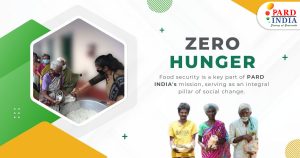
Reasons Donations Are Essential in Tackling Rural Hunger
NGO donations lay the financial groundwork necessary to craft and execute sustainable strategies that prevent hunger. In contrast to single-event relief efforts, these donations enable NGO for rural health in India to establish formal programs that address hunger from various aspects. Furthermore, they provide short-term food relief to families in need, while making investments toward longer-term development that enhances resilience.
1. Short-Term Relief Through Food Distribution
A very pressing application of donations is for food distribution programs. NGO to donate food in India stock kits with essential items such as rice, wheat flour, pulses, oil, and salt to provide families with the necessary dietary nutrients. These kits serve as lifelines when there are droughts, floods, or spells of unemployment, and the means of income dry up. To illustrate, in rural India, in most areas, farmers tend to remain without income during lean times, making families susceptible. Donations enable NGOs to come in and fill the gap, avoiding starvation and malnutrition. The capacity to mobilize promptly in the event of natural disasters is only possible because of regular donations from donors.
2. Assisting Nutritional Programs for Children
Children tend to suffer the most when hunger hits rural homes. Malnutrition inhibits physical development and stunts brain development, making it more difficult for children to focus in school. Thus, donations under 80G in India to NGOs, which cater to this by means of initiatives like mid-day meals, food delivery through anganwadis, and nutrition camps, are specifically designed.
Moreover, these are financed by donations, which cover the costs of food purchases, transportation, and even nutritional supplements, such as fortified cereal or powdered milk. These programs provide children with well-balanced meals regularly, leading to increased school turnout as well as better health. With sustained support, NGOs can expand these activities to serve more villages, lowering the alarmingly high levels of child malnutrition still found in many rural villages.
3. Empowering Women Through Food Security Initiatives
In the majority of rural communities, women are the caregivers and food handlers. When aid supports women-centered programs, the benefit is doubled. The best NGO in India utilizes donations to implement kitchen garden schemes in which women cultivate vegetables in small plots of land so that they have fresh produce on hand throughout the year.
Additionally, others train women in processing and selling local foods, giving them a secondary source of income. All of these increase food security at the household level while improving women’s confidence and ability to make decisions. Donors indirectly advance gender equality by empowering women with resources that benefit entire households. Women-led projects are generally more sustainable, as the skills and knowledge acquired are often passed on to children and community groups.
4. Enabling Sustainable Agriculture Practices
Agriculture is the pillar of rural economies, but farmers struggle with such challenges as unpredictable rainfall, soil erosion, and deficiencies in modern knowledge. Zero hunger support in India solves these issues with donations to conduct training in sustainable agriculture practices like crop diversification, organic farming, water harvesting, and integrated pest management. By making the farmers aware of environmentally friendly and budget-friendly practices, NGOs assist in enhancing yields without depleting resources.
Hence, donations can also be used to deliver quality seeds, farm tools, or climate-resilient agricultural training sessions. The more productive farmers become, the more the food supply in the community is heightened, thus lessening hunger and reliance on outside assistance. Therefore, donors become key partners in developing sustainable farming systems that provide food for the entire village.
5. Developing Community Kitchens and Food Banks
Community kitchens and neighborhood food banks are effective models for targeting hunger in rural communities. With funding from donors, NGO for rural health in India establish kitchens that serve healthy meals at low cost and distribute these to vulnerable groups such as children, the elderly, and foreign workers. Food banks, by contrast, gather excess food from markets, homes, or institutions and redistribute it efficiently.
Furthermore, such initiatives are dependent on donations to meet running costs such as transportation, personnel, and kitchen facilities. By giving, donors make it possible to create mechanisms in which food is not wasted and no household ever lacks a meal. The sense of community brought about through these efforts creates bonds of solidarity in rural communities, establishing safety nets that extend beyond times of crisis.
6. Raising Awareness on Nutrition and Health
In some rural regions, hunger is not a matter of lack of food. It is likewise a lack of information. Families might possess food but lack the knowledge to make well-balanced meals or forgo essential nutrients for staple-rich diets. Contributions enable NGO to donate food in India to stage health camps, cooking demonstrations, and publicity campaigns on well-balanced diets, lactation practices, and cleanliness.
Additionally, such initiatives incorporate local health workers who provide training on low-cost nutrition techniques, including the practice of mixing lentils with cereals for overall protein consumption. Donations enable such campaigns to extend to isolated villages so that communities can acquire the information necessary to make well-informed decisions. However, this information averts malnutrition in the long run, even when food becomes more accessible.
7. Developing Long-Term Food Security Systems
In addition to immediate relief, a donation under 80G in India enables NGOs to invest in long-term food security systems that guarantee future sustainability. Grain banks would allow households to borrow food during hungry months and repay it after harvest. Banks ensure that farmers always have access to high-quality inputs, thereby reducing their dependence on external suppliers. Donor-funded cooperative farm models allow small farmers to share resources and sell their crops in bulk for more money.
Likewise, NGO-funded irrigation projects also increase crop predictability. Such system interventions safeguard rural communities against seasonal hunger, guaranteeing that no household falls into crisis. Donors become silent business partners in the creation of robust community-led networks that provide present and future generations with security against hunger.
Wrapping It Up!
Rural hunger is more than a lack of food, resulting from more fundamental social and economic disparities that breed cycles of poverty. Donations to the best NGO in India serve as strong agents to end this cycle by offering direct relief, nutrition for children, empowering women, educating farmers, and building sustainable food security systems. Every donation, no matter how small, supports work bringing dignity, hope, and self-sufficiency to rural families.
NGOs such as PARD INDIA reflect this vision of zero hunger support in India at the source, and promote education, skill building, and empowerment in rural areas. Donating to such NGOs is not charitable. It is an investment in the future of communities that should be given equal chances to develop. Hunger is a growing problem, but with ongoing donor commitment and concerted grassroots efforts, rural India can look forward to a future where no family or child lies awake hungry.
 :
https://in.pinterest.com/Pardinida/
:
https://in.pinterest.com/Pardinida/